
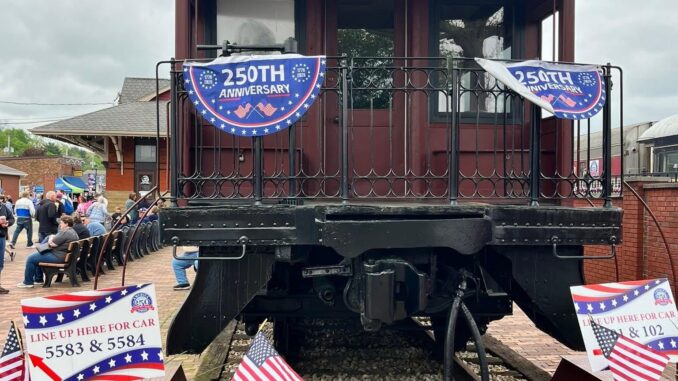
America 250 brings history, economic development and a vison of Ohio’s future
By Joe Frye
This April, a 17-car passenger train rolled through Ohio towns lined with waving flags, carrying travelers, actors portraying historic figures and a vision of transportation of yesteryear. Aboard, riders sampled Ohio-made foods, listened to stories about communities along the rail corridor and interacted with figures such as Abraham Lincoln, Annie Oakley and Neil Armstrong.
Called the Buckeye Train, this excursion organized by the Dennison Railroad Depot Museum, was a two-day train ride that traversed central and eastern Ohio April 25-26.
“This was never just about the Buckeye Train,” says Wendy Zucal, executive director of the Dennison Railroad Depot Museum and one of the event’s leaders. “This was an opportunity to create momentum.”
As Ohio prepares to commemorate the nation’s 250th anniversary, communities across the state are using events not only to honor the country’s history, but to drive tourism, infrastructure investment and long-term economic development. Through America 250-Ohio, cities and towns across the state are organizing festivals, projects and more designed to draw visitors while celebrating local history and culture. At the center of the celebration is the America 250 Commission.
“America 250-Ohio isn’t just a commemoration—it’s a catalyst for growth,” says Todd Kleismit, executive director of America 250-Ohio. “Through grant programs that help communities bring projects to life, the development of tourism trails that encourage visitors to explore unusual and unique sites, and by spotlighting events across the state, we’re driving meaningful economic impact.”
To spotlight these sites across the state, America 250-Ohio is helping coordinate hundreds of events and experiences across all 88 counties as part of the state’s celebration of the nation’s 250th anniversary. The initiative includes statewide programs such as the Ohio Transportation Trail, Ohio Goes to the Movies, Ohio’s Homecoming & Picnic series and community mural projects designed to highlight local history and attract visitors.
Other events tied to the commission range from innovation expos and educational webinars to Revolutionary War reenactments, aviation programming and regional festivals celebrating Ohio’s contributions to industries such as transportation, music and manufacturing.
The Buckeye Train is just one of several events connected to America 250-Ohio. While anniversary celebrations often focus primarily on historical remembrance, organizers across Ohio argue that the initiative can instead act as a launch point for economic growth and tourism development.
In Dennison, a village halfway between Columbus and Pittsburgh with deep railroad history, the train ride provided an opportunity to showcase both its history and its potential future.
Dennison’s railroad depot is a National Historic Landmark because of its role as a World War II canteen, where volunteers served traveling service members during the war. The village also sits along the historic Panhandle rail line, once a part of the Pennsylvania Railroad.
Zucal says organizers realized early that transportation could become a compelling way to connect Ohio’s past with its future. “Transportation is so fundamental to how Ohio was built,” she says. “From canals to railroads to aviation, Ohio has been a leader in these developments and industries.”
That history became the foundation for an event that Zucal says will extend well beyond the train itself. In Dennison, visitors took part in a festival featuring vintage aircraft displays, steam engines, car shows, food vendors, live entertainment and World War II-themed exhibits. The event involved partnerships with multiple railroads, local governments and transportation agencies, as well as support from communities along the route.
“It took a tremendous number of partners,” Zucal says That collaborative approach reflects a broader goal behind many America 250 initiatives. The hope with the event, according to Zucal, is to encourage communities to work together to generate long-term regional impact.
As such, the Buckeye Train’s economic footprint extended far beyond Dennison. According to Zucal, visitors traveled from 28 states and two countries to attend the event. Using attendance estimates and tourism formulas provided by the state, organizers estimate the two-day celebration generated roughly $2.15 million in economic activity.
“We know people stayed overnight,” Zucal says. “They ate everywhere. They stayed in hotels. This was not just a one-day trip for a lot of visitors.”
The event also prompted infrastructure investments that organizers hope will continue its effects after the anniversary celebrations conclude. Newark, for example, constructed a new downtown boarding area for the train.
For Zucal, the event demonstrates public demand for expanded rail tourism and passenger transportation across Ohio. “We just gave a really good case study,” she says. “We showed it can work.
“Railroad history is something that connects with everybody,” Zucal says. “There’s a nostalgia there. People have family histories connected to the railroad. It’s part of Ohio’s identity.”
That emotional connection became clear as residents gathered along tracks waving flags and photographing the train as it passed through small towns. “I had people tell me they almost cried because it was so beautiful,” Zucal says. “You could feel the pride.”
As America 250 celebrations continue across Ohio over the year, the commission hopes that the combination of pride, tourism and economic investment will remain central to the initiative’s mission.
“Events like the 250 Buckeye Train & Transportation Celebration in Dennison, Ohio—which generated an estimated $2.5 million in spending over a single weekend—show how investing in tourism and history can translate directly into opportunity for Ohio’s communities,” says Kleismit.
Rather than treating history solely as something to commemorate, Zucal says she and many other communities across the state are using the anniversary as an opportunity to rethink downtown development, regional tourism and public gathering spaces. “This was never just about the Buckeye Train,” Zucal says. “This was an opportunity to create momentum.”